Thursday, October 22, 2015

Ordinary life / Creating routines

About a week and a half ago I thought it would be good to share something of a "regular day" since a lot of this blog has been around activity beyond our regular days.  Then it took about a week and a half before we had a regular day.   But here it is.  I wondered what might be the most appropriate title for this post.  Initially I thought I'd simply say "Ordinary life," but I can't say all of what we are living feels "ordinary" yet.  What we are doing is trying to establish routines that help us organize our time and energy, and help us through our adjustment.

Breakfast table.  I've been making baked oatmeal (I'll cite Mom's cookbook and Aunt Lorraine's recipe) fairly regularly as our alternative to cereal, which is expensive.  We're not at a rice-and-beans-for-breakfast stage yet.

The walk to school. Around 4 blocks. Sometimes Silas can be a stinker about only wanting to be carried the whole way, but today he was okay with being held just across the roads, and basically walking the rest.

Often Rebekah and I are the first to arrive at the office after dropping the kids off.  Task one: a cup or two of ice water.  Task two: the coffee.

Our office.  Rebekah's desk side. (Note the list on the whiteboard of how much she has assigned for me to do!)

 Our office.  Derrick's desk side.

 Back at Preescolar Globitos to pick up the kids.  Silas at the playground.

Lia in the doorway of her classroom.

Lunch was quiet today with two of our staff out.  Quiet as lunch can be with Lia and Silas present.  This has not been an easy part of our day.  Yolanda prepares wonderful food and everyone has been really flexible as our children test our public parental performance.

Here's a good moment. Our kids at their best.  Lia and Silas pulled out the chairs for the second day in a row to give a "school concert" of all the Spanish songs they know (I was their only audience).  Makes me proud. Looking forward to the Good Charles Family Band Christmas recording for 2015.

 Today it was my turn to be with the kids at home in the afternoon. On the way home we stayed in the park a little to watch some park repairs that are underway.  The task of the moment was to put a new concrete surface the basketball/soccer court.

 Back at the house, we attempt quiet time. Silas wrestles a chair.

Lia sings and colors.

 Quiet time is over and we hear the ice cream man ringing his bells.  I'm slow to get the gate unlocked.  Lia and Silas produce enough volume to make sure he knows he has buyers.

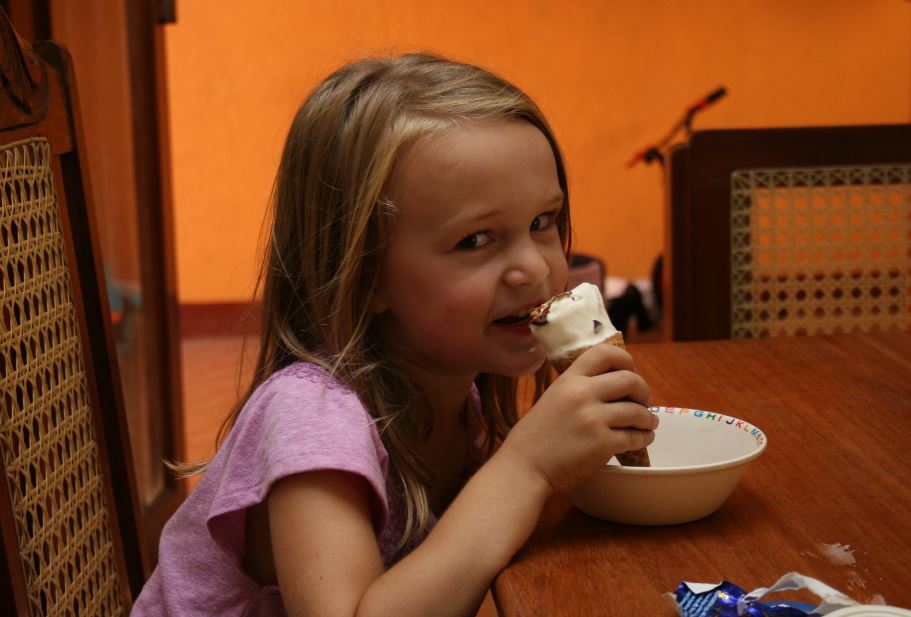
The Super Cono today.

A conversation with my brother and his family.  Much to be said about the wonders of Skype.


Rebekah made fried rice with leftovers from Pollo Estrella (a restaurant), a grilled chicken fundraiser from church last Sunday, and yesterday's supper.  Nicely done.

Wrapping up the kids' day with stories.  Tonight Lia chose a book about fireflies and a Fancy Nancy book on poison ivy.  Right now Silas only wants to hear Danny and the Dinosaur and Magic School Bus: Lost in the Snow (which is a nice thought as we squeeze and our sweat together). All's well that ends well.


Friday, October 16, 2015

Evaluating Conservation Agriculture

This past week was a big event for the MCC Nicaragua effort with Conservation Agriculture with partner ADENOCH in northern Chinandega. The previous week, part of the evaluation team was carrying out the same study across the border with MCC partner CODESO in Honduras. It would be a long week away from family, which wasn't easy.  At the same time it was an important evaluation since conservation agriculture has been a significant part of MCC Nicaragua's work in the last few years. Chris Woodring, our fearless evaluation leader, will be putting together the official report.  Here's my little picture and caption report.

Focus groups.  Over three days our team carried out a total of 8 focus group meetings within four of the five municipalities that ADENOCH works in.  We were gathering data on food consumption, fields, practices, and harvests and perceptions and ideas around advantages and disadvantages of the conservation agriculture approach. (thanks to Chris for sharing some of these pictures)


Field visits. The participating farmers' fields were mapped out and then we selected at random the fields that would be visited. There are around 200 participating farmers in ADENOCH's project, so we wouldn't come close to getting to all of them.  I think our total was around 50, which exceeded what the evaluation framework called for. We saw quite a variety of quality in these fields - some great plots and some terrible ones as well.  The conservation ag concept is basically three principles which are applied and adapted according to the resources of the region: soil moisture through ground cover, minimal soil disturbance (no till), and crop rotation.  Here that has meant ground cover through leftover crop residue of corn, sesame, or something else; digging 15 cm x 15 cm x 15 cm holes that are carefully spaced and filling them with manure; and rotating corn and bean crops (and anything else if they have it).  I should also mention that it was a beautiful place for hiking around these communities, and I am also completely amazed by the strength of these farmers to farm the kinds of terrain that they are working with.


One of ADENOCH's staff, Pascual (who is technically with Fundación Cristiana), in front of his own plot (across the road).

 Other ADENOCH/Fundación Crisitiana staff, Heydy and Olvin at the top of a steep conventional method plot.

Great rains were falling the days that we were in the area.  We would slip under the nearest roof to wait out the heaviest rain.
As a side note, gold is actually a significant export in Nicaragua and it's not unusual to see a mortar and pestle that folks will use to sort through soil from nearby mines.

Here's the part of the team that was staying at the hotel during the Nicaragua side of the evaluation: Denis, from another organization in Nicaragua called CEPAD; Chris, evaluation leader from Kentucky; myself; Adolfo, coordinator of the CODESO organization in Honduras.  These folks, plus the ADENOCH staff on the evaluation team, were great to work with.  Lots of learning!

Findings. We'll have a better sense for some of this after the "data-crunching" stage and the final report is completed.  At the moment it seems that the bright side is that significantly more is being grown within the conservation ag. plots compared to an equivalent size of a conventional ag. plot. The CA plots are doing better with the low amount of rain (although they still need something) which is also really important in this area. The unfortunate side is that these conservation ag. plots are still quite small and are requiring more work than would permit a farmer to expand this practice into their entire field. In order to make a high-yield-with-little-rain method work in a farmer's full field, it looks like some more thinking and re-thinking lies ahead. Green cover crops? A role for conventional fertilizers already in use? Maybe even herbicide at times?  We'll see...


Wednesday, October 7, 2015

Team Meetings + Fun Day

The Nicaragua/Costa Rica team has made it a tradition to all come together in Managua for a few meeting days and conclude with a fun day escape to somewhere else.  Here's a photo recap from our 2 meetings days and our follow up fun day.

 Rebekah thought it would be fun to make mini-pizzas for the first evening's supper together.  (Our ovens only fit this size anyway.)


 The crusts were actually a nan recipe.


Yum.


A great team to work with! Coming from Nicaragua, Colombia, Kansas, New Mexico, Pennsylvania/Virginia.


Fun day at the Laguna de Apoyo! Here's Rebekah swimming Silas out to the floating deck in the lake.

We rented kayaks, and the kids are with adults on their laps.  This worked well except...

...the waves were picking up in the afternoon and Dency and Genesis tipped over!  We were all a little startled, but were glad that everyone was fine.


Here's the group shot at the end of the day. For those who read about Granada a few weeks ago, that's the Volcan Mombacho way in the distance. It was a beautiful day and a great way to wrap up our days together as a team.


Saturday, September 26, 2015

Rebuilding in Nagarote

Last week I wrote about a response to the current drought crisis.  Another problem that Nicaragua struggles with is the seismic activity of the region.  The most destructive earthquake hit Managua in 1972, which was what led MCC to come to the country. Other, smaller earthquakes have continued to be destructive.  As the second-poorest country in the Western hemisphere, the finances and engineering isn't always present in construction as it should be.

Last year, in April, a 6.1 level earthquake hit the town of Nagarote, where the Brethren in Christ have two congregations.  The three Anabaptist conferences in Nicaragua (Brethren in Christ, Convention Mennonite, and Fraternity Mennonite) have worked together to run the Anabaptist Emergency Commission (CAE). In response to the earthquake, along with MCC, the CAE built 8 new homes for people who had lost their homes in the earthquake. 

After a year and a half of planning and building, I was lucky enough to be able to step in at the finish line to celebrate the completion of this work with them.  On Friday I went to Nagarote, where we traveled around the communities there to do the symbolic hand-off of the homes from the CAE and to the new home owners.  Here are some pictures.

 Germán and Mario share a laugh with new home owner Odelma and her children.


 This was the only house that is not yet complete. Like the practice of Habitat for Humanity, the deal with beneficiaries included some "sweat equity." The future owner of this house is a welder who wanted to do his own roof.  Unfortuantely, he's behind schedule.


 Arriving at the new home for Kenia.

Passing over the keys.

This home has a nice view of Momotombo, an active volcano that is also tapped as a source for geothermal electric.

 After our home visits, we gathered at one of the churches for a service of singing, a devotional, and words from people involved in the project. 

 The three presidents of the Mennonite conferences shared reflections and words of blessing (Gerardo, Fraternity Mennonite; Mario, Convetion Mennonite; Pedro Luis, president of the CAE; Germán, Brethren in Christ). Important themes included the value of working together as different conferences on a common project and our call to actively follow Jesus, responding to needs of people around us. 


Sunday, September 20, 2015

Abundance and Scarcity

A day or two ago Silas pulled off the illustrated Bible for children off the shelf for his bedtime story.  I said that we'll randomly open the Bible and read a story or two.  I may have favored the New Testament side in my random opening, but the page I opened to was the story of Jesus feeding the 5,000. A story of scarcity, blessing, sharing, and abundance.

It just so happens that this question of scarcity has been on my mind a lot recently.  Since we arrived in Nicaragua, one of the first issues we needed to think about was the severe drought that was being experienced throughout Central America's dry corridor. These are considered effects of climate change and the El Niño phenomenon.


MCC partners with an organization, called ADENOCH  (Asociación para el Desarrollo del Norte de Chinandega) within this area, working with conservation agriculture (I showed some pictures of this back in July).  Unfortunately, not much will grow without any rain, even with conservation agriculture methods.  The first planting did not yield a harvest, which left farmers without seeds for the second planting.  MCC worked together with the Canadian Foodgrains Bank in a relief project to distribute seed and food to families in most need throughout the communities where ADENOCH works.

I'm still just learning about the Canadian Foodgrains Bank, but it is a great program and MCC has been closely involved with them since their beginning. I understand that one of the ways that funds come into this program is through Canadian farmers who donate their crop to CFGB, who sells it and then uses those funds around the world.  It used to be that they would send the grain itself; today it is more cost-effective to procure grains, food, etc, closer to the population in need.

This past week, ADENOCH rushed to get seeds out in time for the second planting. On Saturday, I made a trip up to the area to see how the food distribution is going.  Here's a map so you can see more or less where I'm talking about.


This particular path passes by a row of volcanos. Here's the last one I passed, San Cristobal, the tallest in the country at 5,275 ft and remains active coughing dust now and then. 


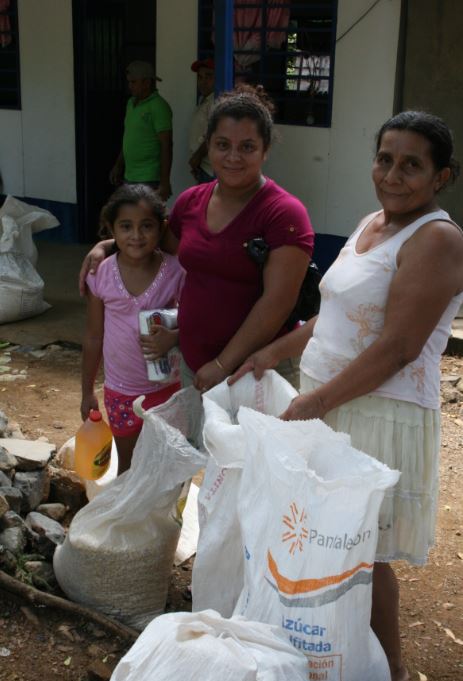
When I arrived, the director of ADENOCH, Elder, briefed me on what was going on. We were in a community called Los Pozos, where the people who had been invited had gathered for the distribution.  An ADENOCH board member would open with a prayer, Elder would speak, and then I was supposed to speak. Oh, ok, the impromptu speech. I told about the farmers who give to CFGB and the story of Jesus feeding the 5,000 that we happened to read with the kids the other day.  Realizing that there are many more people in the dry corridor than what we were serving through this project, I mentioned that this feels in someways like 5 loaves and 2 fish.  May God bless the seed and the food for these families and beyond.


(Alison Franceli Cali Vallecío, Claydis Junieth Vallecio Mejía, Franscica Vallecio Ochoa)

(Gunner José Aguilera Martinez, Lucía Olga Martinez Espinal)


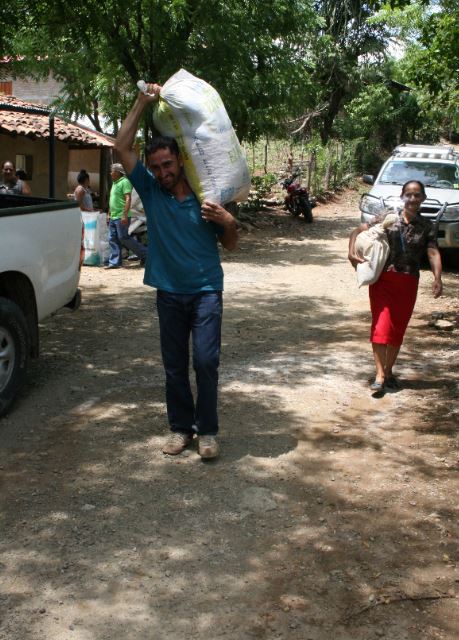
From there, we continued to another community called Las Lajitas for the same routine.  I appreciated the Toyota Hilux power on these roads. I'm not sure this picture captures the scale of some of these inclines/declines, but it's what I got.


(Gerardo, ADENOCH board member)


Once again, people were grateful and it was humbling to be in a position to be able to connect people and resources.


Some happy kids playing baseball.


From there, I went to join the ADENOCH staff that were present for lunch and then met with Elder back at his office for a while to talk through details about how the rest of the distribution would be happening, how the follow-up happens, etc.

The night before I traveled up the area had received a tremendous rain, the most significant rainfall they have had since June. I hadn't traveled far before another thunderstorm opened up.  It was a great moment (even though it becomes exhausting to drive with rain, dusk/night, horses and cattle crossing the street, major potholes to avoid, people walking or biking beside the road, etc.).  I called Elder back in Managua and asked if he had gotten the rain.  Unfortunately, this one was just south of them, and some of their communities would have gotten the rain, but where he was, very little fell. We'll keep them in prayer for the next one.